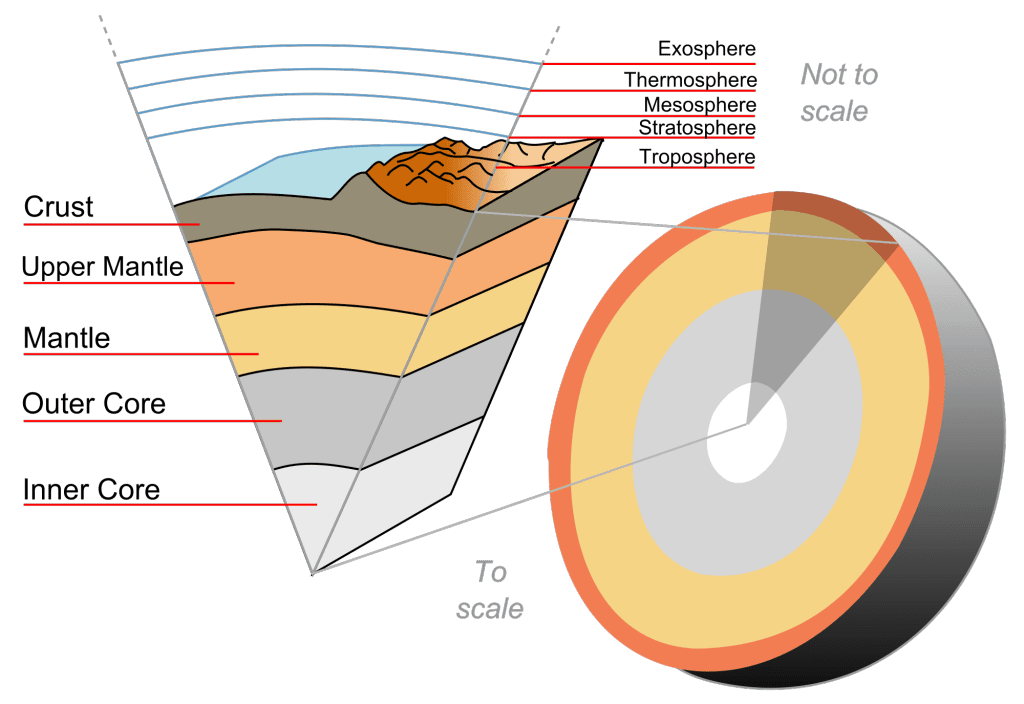
The Crust
The crust is everything we can see and study directly. The thinnest layer of the Earth, the crust still measures about 40 km on average, ranging from 5–70 km (~3–44 miles) in depth. But at the scale of the planet, that’s less than the skin of an apple.
There are two types of crust: continental and oceanic crust. Oceanic crust can be found at the bottom of the oceans or below the continental crust; it is generally harder and deeper, consisting of denser rocks like basalt, while continental crust contains granite-type rocks and sediments. The continental crust thicker on land.
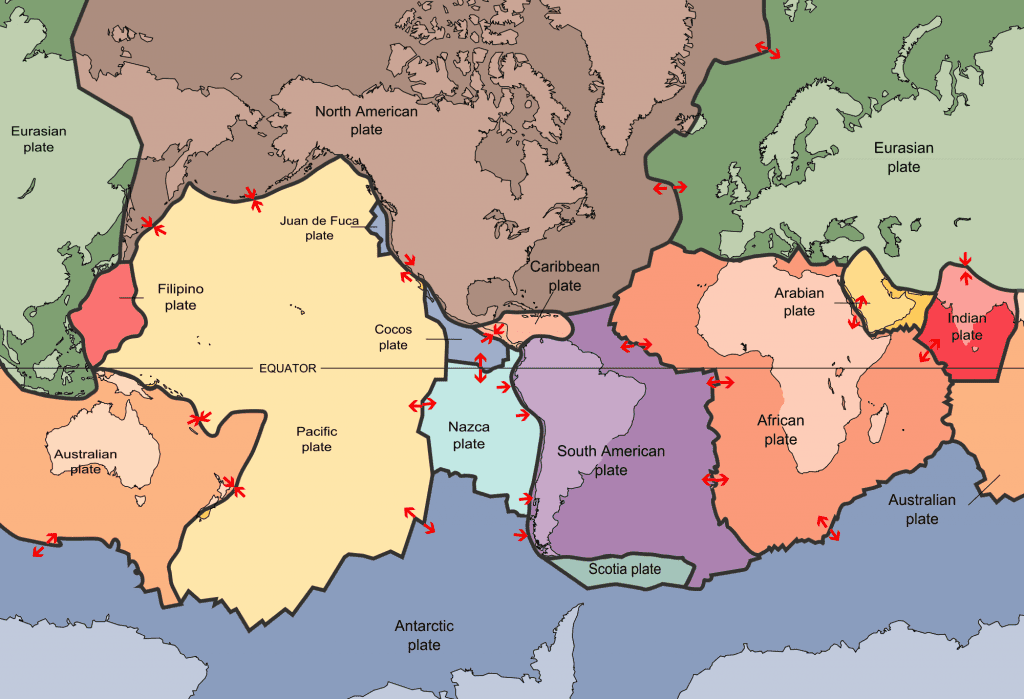
The crust is not one rigid thing, but it’s split into several tectonic plates. These tectonic plates are not stationary, but are in relative motion one from another. Depending on the relationship and geologic setting, there are three types of tectonic plate boundaries: convergent (moving one toward the other), divergent (moving away from the other) and transformant (moving laterally).
These plates “float” on the soft, plastic upper mantle.
The Mantle

The mantle extends down 2,890 km, making it the thickest layer of Earth. It makes up about 84% of Earth’s volume. Everything we know about the mantle we know indirectly, as no human study managed to go beyond the crust. Most of the things we know about the mantle we know from seismologic studies (more on that later).
The mantle is also divided into several layers, based on seismologic properties. The upper mantle extends from where the crust ends to about 670 km. Even though this area is regarded as viscous, you can also consider it as formed from rock – a rock called peridotite to be more precise. Below that, the lower mantle extends from 670 to almost 2900 kilometers below the surface.
The Core
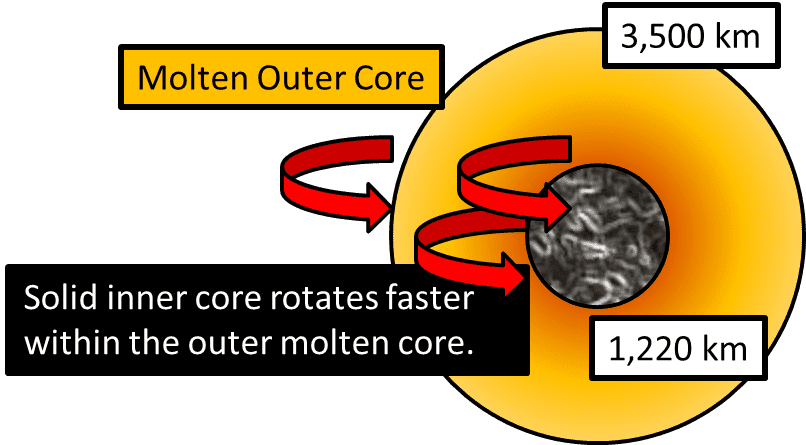
We sometimes refer to the core as one thing, although the inner core and the outer core are fundamentally different – not layers of the same thing. The “solid” inner core has a radius of ~1,220 km, while the “liquid” outer core extends up to a radius of ~3,400 km.
Wait, if we couldn’t go to the mantle, how could we possibly know one is solid and one isn’t? Well, as before, the answer is the same: seismic waves (we’re almost there).
The Inner Core
The temperatures and pressures of the inner core are absolutely extreme, at approximately 5,400 °C (9,800 °F) and 330 to 360 gigapascals (3,300,000 to 3,600,000 atm).
It’s generally believed that the inner core is growing very slowly – as the core cools down, more of the outer core solidifies and becomes a part of the inner core. The cooling rate is very low thought, at about 100 degrees Celsius per billion years. However, even this slow growth is thought to have a significant impact in the generation of Earth’s magnetic field by dynamo action in the liquid outer core.
The Outer Core
The outer core is a low viscosity fluid (about ten times the viscosity of liquid metals at the surface) – “liquid” is a rather improper term. Because it has a very low viscosity, it is easily deformed and malleable. It is the site of violent convection. It is also thought to suffer very violent convection currents – hey, and guess what? The churning of the outer core and its relative movement is responsible for the Earth’s magnetic field.
The hottest part of the outer core is actually hotter than the inner core; temperatures can reach 6,000° Celsius (10,800° Fahrenheit)—as hot as the surface of the sun.
 Terra Nostra