The word “Metamorphism” comes from the Greek: meta = after, morph = form, so metamorphism means the after form. In geology this refers to the changes in mineral assemblage and texture that result from subjecting a rock to conditions such pressures, temperatures, and chemical environments different from those under which the rock originally formed.
Note that Diagenesis is also a change in form that occurs in sedimentary rocks. In geology, however, we restrict diagenetic processes to those which occur at temperatures below 200oC and pressures below about 300 MPa (MPa stands for Mega Pascals), this is equivalent to about 3 kilobars of pressure (1kb = 100 MPa).
Metamorphism, therefore occurs at temperatures and pressures higher than 200oC and 300 MPa. Rocks can be subjected to these higher temperatures and pressures as they are buried deeper in the Earth. Such burial usually takes place as a result of tectonic processes such as continental collisions or subduction.
The upper limit of metamorphism occurs at the pressure and temperature where melting of the rock in question begins. Once melting begins, the process changes to an igneous process rather than a metamorphic process.
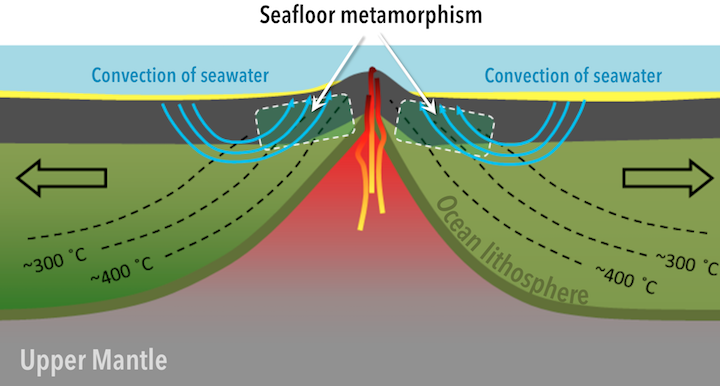
Hydrothermal Metamorphism
Rocks that are altered at high temperatures and moderate pressures by hydrothermal fluids are hydrothermally metamorphosed. This is common in basaltic rocks that generally lack hydrous minerals. The hydrothermal metamorphism results in alteration to such Mg-Fe rich hydrous minerals as talc, chlorite, serpentine, actinolite, tremolite, zeolites, and clay minerals. Rich ore deposits are often formed as a result of hydrothermal metamorphism.
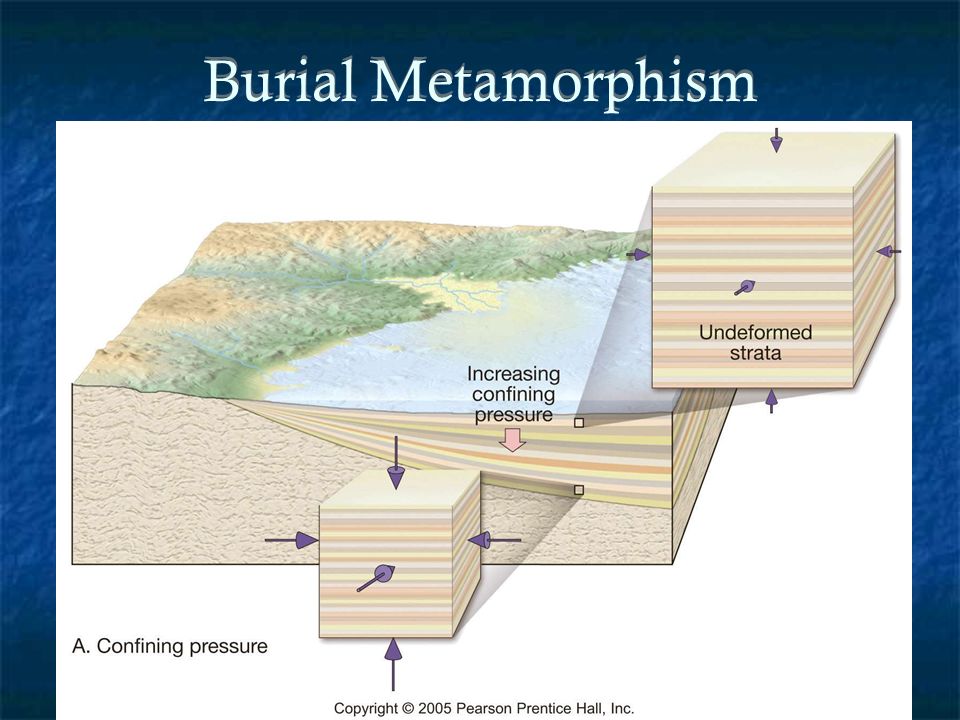
Burial Metamorphism
When sedimentary rocks are buried to depths of several kilometers, temperatures greater than 300oC may develop in the absence of differential stress. New minerals grow, but the rock does not appear to be metamorphosed. The main minerals produced are often the Zeolites. Burial metamorphism overlaps, to some extent, with diagenesis, and grades into regional metamorphism as temperature and pressure increase.
Shock Metamorphism (Impact Metamorphism)
When an extraterrestrial body, such as a meteorite or comet impacts with the Earth or if there is a very large volcanic explosion, ultrahigh pressures can be generated in the impacted rock. These ultrahigh pressures can produce minerals that are only stable at very high pressure, such as the SiO2 polymorphs coesite and stishovite. In addition they can produce textures known as shock lamellae in mineral grains, and such textures as shatter cones in the impacted rock.
 Terra Nostra