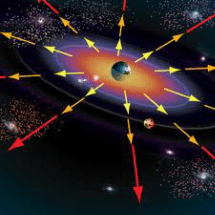
Redshift is a phenomenon where electromagnetic radiation form an object undergoes an increase in wavelength. It also proves Einstein’s Theory of General Relativity.
Edwin Hubble was the first to describe the redshift phenomenon when he, with Milton Humason, extended the work of Vesto Slipher (The American astronomer who carried out the first measurements of radial velocities for galaxies in 1912, using spectroscopy). Hubble used a larger Hooker telescope and took long exposures of spectra in barely perceptible galaxies. Some neighboring galaxies had velocities and gave hints that they were getting closer to our own galaxy , the “Milky Way”. He deduced that galaxies were not so far off in size with each other and that those that appeared smaller were further away from our own galaxy. Hubble discovered a fascinating relationship when he plotted the velocity of the galaxies in relation with their respective distances as they were proportional. This became known as Hubble’s law.

There are three main causes of redshifts in astronomy and cosmology:
1. Objects move apart (or closer together) in space. This is an example of the Doppler effect.
2. Space itself expanding, causing objects to become separated without changing their positions in space. This is known as cosmological redshift. All sufficiently distant light sources (generally more than a few million light years away) show redshift corresponding to the rate of increase in their distance from Earth, known as Hubble’s Law.
3. Gravitational redshift is a relativistic effect observed due to strong gravitational fields, which distort spacetime and exert a force on light and other particles.

 Terra Nostra